
Why You Will Leave the Marine Corps (After One Tour)
Disclosure: As an Amazon Associate, this site earns from qualifying purchases. Links to Amazon on this page are affiliate links — if you buy through them, the blog earns a small commission at no extra cost to you. It’s how we keep the lights on. Semper Fi.
A 2011 study at Harvard’s Kennedy School of Government of young officers who had left the military found that their top reasons for doing so were not the high operating tempo or the chance of being maimed but rather two other factors: “limited ability to control their own careers” and “frustration with military bureaucracy.”
You’re going to enter the Marine Corps a motivated, optimistic Second Lieutenant riding a wave of satisfaction and resolve after passing through the intense test of OCS. Then you’re going to spend six long months at The Basic School frustrated at the endless boring lectures, fifteen hour days of hurry-up-and-wait, and the back-stabbing peer evaluation climate. Finally you will graduate and then spend months more at your MOS (Military Occupational School) slowly dying in 8-hour PowerPoint days (logistics school) or getting hazed by unhinged Captains (infantry). Maybe even looking down the long tunnel of 2-4 years of academically draining flight school at the small light where eventually “it gets better.”

Once you hit the fleet, you probably will finally get that leadership position. And you will find that leading Marines is a wonderful privilege and responsibility. Eventually, however, micromanagement, bureaucracy, and reason-choking conventions will drive you crazy. Intellect and creativity will be sacrificed on the altars of compliance and uniformity. If you can’t resign yourself to the often inefficient or wasteful rules of government life, you will eventually become dispirited and demotivated as you lose the will to innovate. Mercifully, your EAS (end of active duty date) will approach and you will be just as glad on the day you left the Marine Corps as you were proud on the day you joined.
The above is an admittedly pessimistic view of most junior officer’s first tour, but it is a common story, seen again and again. Two-thirds to three-quarters of officers leave the service at their earliest opportunity. They hold many of the same reasons in common. Have you thought about the negatives of serving before committing four years of your life to this organization? Let’s take a hard look at the top reasons why young officers leave the Marine Corps:
Junior Officer’s Top Reasons for Leaving the Military
The following insights are gleaned from one of the only known polls on this issue, Junior Military Officer Retention: Challenges and Opportunities by Sayce Falk & Sasha Rogers, John F. Kennedy School of Government Harvard University. Done in 2011, it sampled JMOs from across all services.
Inability to Choose Career Paths
At TBS, you will be assigned a general Military Occupational Specialty, or job field. About 85% of lieutenants get one of their top 5 picks. That means 3 in 20 officers do not even get one of their top 5 choices. For their career! These MOSs include such fields as infantry, artillery, logistics, communication, administration, combat engineering, intelligence, and supply. Your MOS will have a huge impact on what your military career will be like. In addition, after you leave the military, your MOS could drastically focus or limit your job options. And all that changes in one somewhat random decision after only a couple months of observation in The Basic School. After that, your career changes are processed in a similar fashion. The “Needs of the Marine Corps” will dictate what jobs you have, where you live, and who will be your boss.

Since you’re just a number to the Marine Corps, personal talents, interests, and relationships will not necessarily count for much. Your preferences will ostensibly (although opaquely) be considered as part of the process, although you generally will only get to voice geographic preference. As you grow to know yourself better and understand where you would be happiest, this will frustrate you at some point in your career. Possibly enough to make you prefer the freedom of civilian life.
Organizational Flexibility. The number one reported reason for separation among our respondents was limited ability to control their own careers. Frustration with a one- size-fits-all system was by far the most common complaint, with emphasis on bureaucratic personnel processes that respondents called “broken,” “archaic,” and “dysfunctional.”
Bureaucracy Über Alles
From officer evaluations to promotions to job assignments, all branches of the military operate more like a government bureaucracy with a unionized workforce than a cutting-edge meritocracy. -Tim Kane, Bleeding Talent
 The Marine Corps is not a profitable business. There is no guiding bottom line incentivizing efficiency. The military is just as subject to waste, inefficiency, and strategic misdirection as any other government branch. Rules, manuals, and tradition dictate almost everything about how an officer does his job. The better you are at following the party line and executing pre-ordained instructions, the better your service will go. Creativity or out-of-the-box thinking is not a priority in the military as a whole, and especially in the Marine Corps. Some people seem to thrive in such environments, while more creative “right-brain” individuals often are very frustrated with such a robotic system.
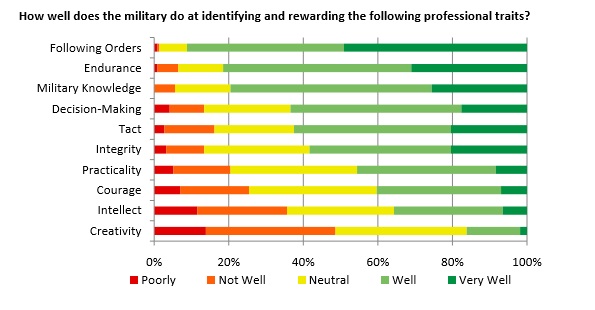
Commitment to Innovation. In second place, 41% of respondents ranked frustration with military bureaucracy as the most or a very important factor in their decision to leave. Nearly half felt the military did a poor job at identifying and rewarding traits such as creativity, as opposed to qualities such as endurance or ability to follow orders.
Other Commonly-Cited Concerns
Those are the top two reasons that junior officers give for leaving the military. In the research, they outranked all other concerns in the frequency with which they were expressed. Some of the other top factors were as follows:
- Quality of Life. Including concerns for family time and work/life balance.
- Operational Tempo. The officers polled left from 2001-2010, most during a uniquely stressful high-tempo period of deployments to two wars.
Generally, “financial compensation” and “weak superiors” were not impactful concerns.
The Bottom Line: Take Stock
Apologies if this post has you feeling demotivated, apprehensive, or doubtful. In the end, you should make a well-informed decision, considering positive and negative aspects of service. Look at your own personal employment history, and see how you may react to these aspects of military life. Take a personal inventory to truly understand what motivates you, how you like to learn and work, and how you may react to the specific traits that the military values or devalues. Will you want to leave at your earliest opportunity? Will you be the one-in-three who prefer to stay? You can’t really know until you join, but you owe it to yourself and your family to make a wise choice with four years of your life.
Good luck and may you find the best answer for yourself.
References
- Bleeding Talent: How the US Military Mismanages Great Leaders and Why It’s Time for a Revolution, Tim Kane, 2012
- Junior Military Officer Retention: Challenges and Opportunities by Sayce Falk & Sasha Rogers, John F. Kennedy School of Government Harvard University, 2011
- The Generals: American Military Command from World War II to Today, Thomas E. Ricks, 2012
-
Why Our Best Officers Are Leaving, Tim Kane, The Atlantic January/February 2011
Related Posts

This Will Make You Rethink Marine Commissioning Routes
Before I graduated OCS, I tried every one of the commissioning routes, save enlisted to officer. I applied to the Naval Academy twice and spent a year and a half as a Marine Option Midshipman in NROTC. Only after that did I apply for the Platoon Leaders Course and attend the 10 week PLC combined. To be clear, good and bad officers come from all of … Continue reading This Will Make You Rethink Mari

NROTC To OCS
Thanks to MIDN 1/C C for sharing his leadership experience and advice for candidates heading to OCS. NROTC Midshipman, utilize the resources you have through NROTC to go prepared to OCS. NROTC preparation I came from Norwich University, a small military college in the middle of Vermont. We, just like every other NROTC unit, have Marine Officer Instructors’s and Assistant Marine Officer Instructors

Candidate Hindsight is 20/10
Thanks to 2ndLt Y for passing along his knowledge and wisdom as a successful Marine Officer candidate at OCS. Life of a Marine Officer Candidate OCS is different from college in every way. As a candidate just be comfortable being uncomfortable. Go in with the attitude that nothing is going to surprise you, that way you don’t have to worry about being surprised. Some things are absolutely … Contin